Insights
When Change Management Goes Too Far
Leadership and Facilitation

Summary
Rather than indulging in endless theatre for universal buy-in, mature organizations drive progress by shifting behaviors first through clear decisions and clean consequences.
At a leadership offsite recently, I found myself listening to a familiar discussion about the need to “take our people on the journey.” There was talk about bringing people with us, creating buy-in and making sure the change did not feel as though it was being done to people. Eventually I said: give yourselves permission to make the journey very short. It needed saying.
“Taking people on the journey” sounds unquestionably virtuous. But somewhere along the way, sensible concern for the human side of change has morphed into the idea that employees should not be expected to change until management has successfully persuaded them to want the change. Change programs start consuming more energy than the change itself. We are no longer taking people on a journey. We are negotiating about whether the train is allowed to leave the station.
How much “desire” for change do we really need?
Prosci’s ADKAR, one of the best-known change frameworks, places Desire immediately after Awareness and before Knowledge, Ability and Reinforcement. The logic is seductively tidy: first employees understand why change is necessary, then they want to participate, then they learn what to do, acquire the capability and make it stick.
The D is the problem. How much room is there, really, for desire in a professional workplace? Bono had other things in mind.
Organisations are large, complicated systems with customers, competitors, regulators, shareholders and other stakeholders making competing demands. Strategies change. Budgets get cut. Mergers merge. Products launch, relaunch and disappear. Not every decision will coincide with the desire of every employee affected by it.
We have become understandably wary of change being done to people. But occasionally it is. That is not necessarily poor change management. It is one reality of working inside an organisation you do not own. Employees receive considerably more certainty than entrepreneurs, including the rather attractive convention of a salary appearing in their bank account every fortnight. Part of that bargain is accepting that other people sometimes make decisions you would not have made yourself.
Employees should challenge bad thinking, identify risks and use evidence to influence decisions. Organisations desperately need people willing to do that. But the right to have a voice is not the right to remain unchanged until you have been personally persuaded.
In 2002, Canadian organisational psychologists Lynne Herscovitch and John Meyer distinguished three types of commitment to change:
• Affective commitment: I support the change because I want to.
• Normative commitment: I support it because I feel I ought to.
• Continuance commitment: I support it because the costs of not doing so are too high.
All three can produce behaviour supportive of change, though only one, “because I want to”, sounds much like Desire to me. Wanting to is valuable when change requires discretionary effort, advocacy or judgement in fundamentally new ways. But it is not the only legitimate route to changed behaviour.
COM-B, developed by Susan Michie and colleagues, offers a useful contrast. It includes Motivation, but does not make it a sequential gate before capability and behaviour. Behaviour is treated as the product of Capability, Opportunity and Motivation interacting. That feels closer to organisational reality: people can start doing something differently because the system requires and enables it, while their attitude catches up later.
Daryl Bem’s self-perception theory gives another reason to question the sequence. Particularly when our attitudes are not strongly held, we partly infer what we think from observing what we do. Someone volunteers once, does it again, and gradually sees themselves as the sort of person who volunteers. Sometimes we do not need to think our way into new behaviour. We can behave our way into a different mindset.
Good leaders do not start every change program with an empty trust bank
Good leaders do not start each change program with an empty trust bank. They have been making deposits for years through consistency, candour, good judgement and doing what they say they are going to do. Over time, employees learn whether these are people whose judgement deserves the benefit of the doubt.
A healthy organisation should accommodate an employee who thinks, “I would not have chosen this, but I trust the people who did. I understand what is being asked of me, and I am going to help make it work.” If every change requires a months-long campaign to persuade employees that management has the right to make it, the organisation may have a trust problem masquerading as a change problem.
Stop selling the future and fix Monday morning
Organisations can spend enormous amounts of time communicating why the future must be different while remaining remarkably vague about what anyone should actually do differently.
The burning platform is magnificent. There is an infographic showing the From-to transition, a town hall and workshops. Then Monday morning arrives and the same tools, meetings, templates and roles persist. The system makes the old behaviour not just easier but the obvious choice. Six months later, management concludes that people are resistant to change. Maybe they are, but management has also made resistance incredibly convenient.
Even McKinsey’s Influence Model, which gives the expected nod to “understanding and conviction,” puts three other levers alongside it: formal mechanisms, skills and role modelling. In practice, I often see organisations lavish effort on the first and underinvest in the other three. The vision has been sold beautifully. The actual work has barely changed.
Before diagnosing a mindset problem, leaders should ask a less glamorous question: have we made it unmistakably clear what people are expected to do differently, and changed the organisational environment enough to support it?
And what to do about it: a Change Exchange
The world does not need another change-management framework, but I have come to use a more practical test with clients. Nothing in it is revolutionary in isolation. The difference is where it starts: not with how to maximise buy-in, but with how much buy-in the change actually requires.
It asks two questions: what does leadership need from the people they lead, and what do people need from leadership?
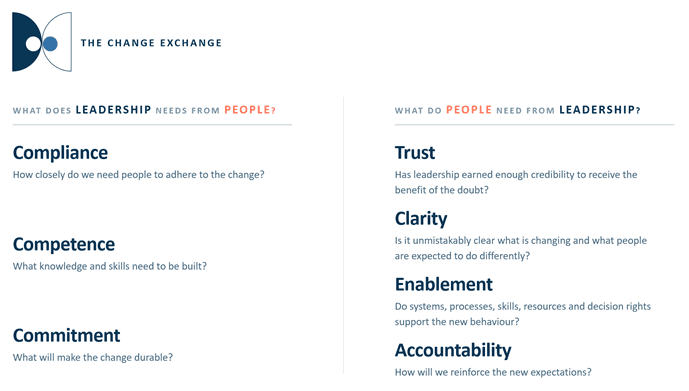
First, leadership decides what it actually requires. Sometimes it is compliance: follow the new direction. Sometimes it is competence: learn to operate effectively in a different way. Sometimes it genuinely needs commitment: enough belief in the direction to exercise judgement, discretionary effort and advocacy. Those are very different asks and should not attract the same amount of change management.
In return, people need trust in the people making the call; clarity about what is changing and what they must do differently; enablement through systems, processes, skills and resources; and accountability that reinforces the new way rather than quietly tolerating the old one.
I think of this as a reciprocal change contract. Employees do not owe leadership enthusiasm. Leadership does not owe employees a veto. But both sides owe the other something.
The Change Exchange is not an argument for less leadership around change. It asks more of leaders: build trust before you need it, be brutally clear about what changes on Monday, put the machinery behind the behaviour you are asking for, and hold people accountable once you have. In return, stop assuming that every employee must arrive at Desire before the organisation is allowed to move.
Sometimes change genuinely needs a journey. But first ask what you actually need from people, and what they need from you. Then make the journey exactly as long as it needs to be. No longer.
Read more articles
Scroll >